
If you’ve ever tried to spot a caracal in the wild, you already know the punchline: you won’t. Not because they’re mythical—caracals are very real, very athletic, and very hungry—but because they’re built to do one thing exceptionally well: move through harsh landscapes like a whisper and strike like a sprung trap.
This is the “ghost of the desert” effect. A caracal doesn’t just hide. It disappears—into sand, scrub, shadow, and silence—while it stalks birds, hares, rodents, and anything else it can outsmart in a few heartbeats. Let’s step into the caracal’s world: the stealth gear, the hunting strategy, and the reason your binoculars keep finding empty horizons.
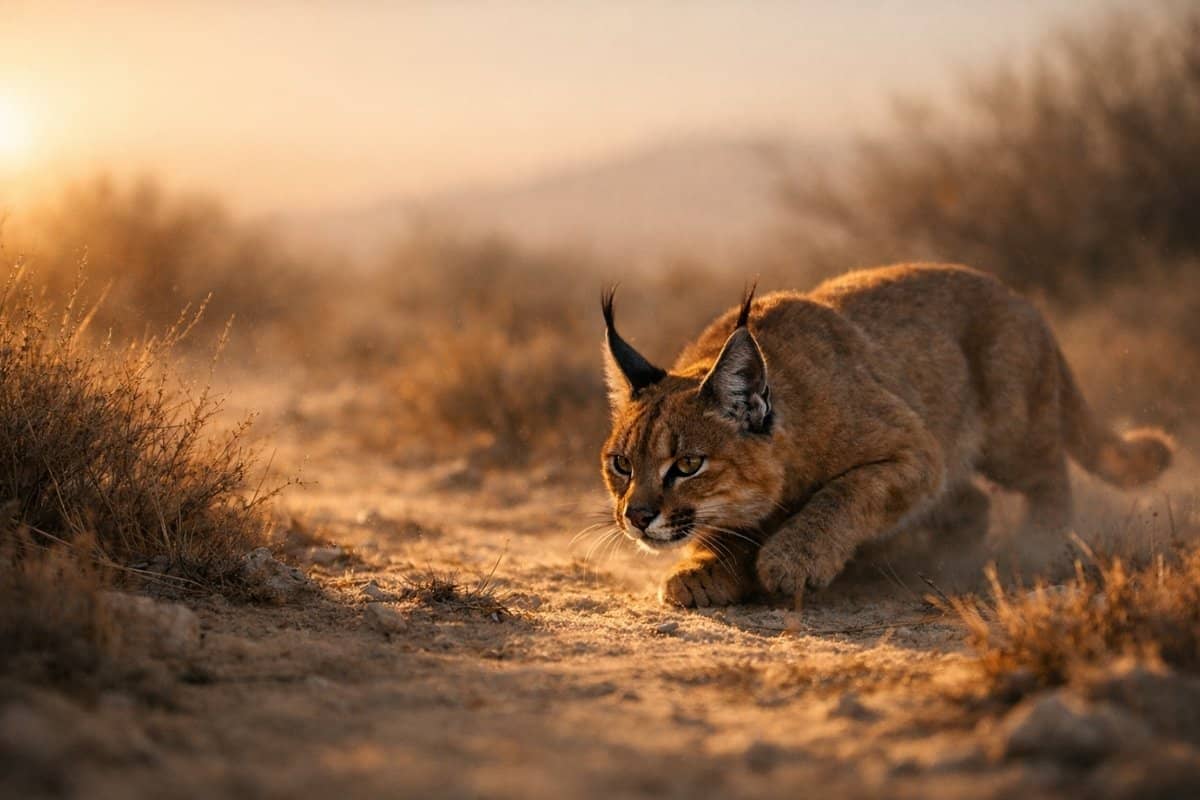
Meet the Caracal: The Silent Hunter with the Wild Ears
The caracal (Caracal caracal) is a medium-sized wild cat found across parts of Africa, the Middle East, Central Asia, and the Indian subcontinent. It’s often described as “lynx-like,” mostly because of those dramatic black ear tufts—but caracals aren’t true lynxes. They’re their own brand of predator: sleek, muscular, and perfectly tuned for stalking in open, unforgiving terrain.
Quick caracal facts for animal lovers and SEO:
- Size: roughly 8–20 kg (varies by region and sex)
- Hunting style: stealth stalk → rapid burst sprint → explosive leap
- Typical prey: rodents, hares, small antelope, birds
- Activity: often nocturnal or crepuscular (dawn/dusk), depending on heat and human presence
But the real headline isn’t their range or their looks. It’s how they move.
How Caracals Hunt in Near-Silence
Silence isn’t one trait. It’s a whole toolkit. Caracals combine sound-dampening movement, precision stalking, patient timing, and sudden acceleration into a hunting style that looks almost unreal when you see it.
1) Soft Feet, Smart Steps: The Sound of Nothing
Caracals don’t stomp across the desert—they place their feet.
Wild cats generally have padded paws, and the caracal is no exception. Those pads act like built-in shock absorbers, muffling impact and helping them move quietly over sand, dry grass, and rocky ground. But the more impressive part is how they walk:
- Slow, deliberate foot placement reduces crunching and scraping.
- Low center of gravity keeps the body stable.
- Weight shifts smoothly from paw to paw, so nothing “thuds.”
In practice, a stalking caracal can cross open ground with the vibe of a shadow sliding across the sand. If the desert is a stage, it’s the actor that refuses to make a sound cue.
2) Camouflage You Don’t Notice Until It’s Too Late
Caracals are painted in desert colors: tawny, reddish, sand-gold. In scrubland and savanna, their coat blends so well that “seeing” one often means noticing the absence of movement—a slightly too-perfect shape in the grass, a patch of earth that suddenly has eyes.
And unlike animals that rely on bold patterns, the caracal’s stealth is subtle. It’s not trying to look like something else. It’s trying to look like nothing important at all.
3) The Ear Tufts Are Not Just for Looks
Those black tufts aren’t decoration. They’re part of the caracal’s sensory and communication toolkit.
Caracals have excellent hearing, and their ears can swivel to pinpoint tiny noises—footsteps in dry grass, the rustle of a rodent, the flutter of a bird settling on the ground. The tufts may help with signaling and breaking up the outline of the ear (making the head shape harder to read), but the big advantage is simply this:
A caracal can hear prey before it can see it.
And in a desert landscape, information is everything.
4) The Stalk: Patience, Micro-Movements, and Timing
A caracal’s hunt often begins with stillness.
When it locks onto prey, it doesn’t rush. It watches. It measures distance. It waits for a moment when the wind direction, cover, and prey behavior align. Then it moves in micro-steps, sometimes pausing for long stretches.
Why? Because prey animals aren’t just watching for predators—they’re listening for mistakes. A bird might tolerate a moving antelope. It will not tolerate a soft-footed cat that suddenly looks “wrong.”
Caracals use:
- Cover (shrubs, rocks, grass clumps)
- Shadow (especially at dusk and dawn)
- Wind (to keep scent away from prey)
And then—when the distance is right—they switch modes.
5) The Burst: From Ghost to Rocket
Caracals don’t win by being the fastest animal in the desert. They win by being the fastest surprise.
Once they commit, they explode forward in a short, powerful sprint. They’re built for acceleration: muscular shoulders and hindquarters, flexible spine, and the cat-style gait that turns the body into a spring.
In hunting terms, the caracal specializes in:
- Short ambush runs
- Quick direction changes
- Explosive leaps
This is why videos of caracals launching into the air look like special effects. It’s all stored energy—released in an instant.
6) The Leap: The Famous “Bird Snatch” Move
Caracals have earned internet fame for their ability to leap high and grab birds mid-air. While not every hunt looks like a viral clip, the caracal really is exceptional at catching birds—especially when they flush from the ground or low shrubs.
Here’s what makes the leap work:
- Powerful hind legs provide vertical lift.
- Fast reflexes time the jump to the bird’s trajectory.
- Forepaws strike with precision, like a catcher’s glove closing at the exact moment.
In the wild, this translates to a practical advantage: birds are calorie-rich and widely available, but hard to catch. Caracals make “hard to catch” look negotiable.
Why You Rarely See a Caracal in the Wild
Now the second half of the mystery: if caracals exist across huge regions, why do so few people ever see them?
1) They’re Active When You’re Not
In many areas, caracals are most active at night or during dawn and dusk—times when temperatures drop and prey is moving. Even in places where they can be more daytime-active, they often shift toward nighttime behavior in regions with heavy human activity.
Translation: your hiking schedule is not their schedule.
2) They Live Where Visibility Lies to You
Caracals thrive in places that look empty: semi-deserts, scrublands, rocky foothills, dry savannas. But “empty” landscapes are full of visual tricks—low bushes, uneven ground, scattered rocks, shimmering heat haze.
A caracal doesn’t need a forest to hide. It needs one bush and good decisions.
3) They’re Solitary and Secretive by Design
Caracals are typically solitary. They don’t move in big groups that create obvious signs. They don’t advertise themselves with constant calls like some animals. Their “default setting” is low profile—because in the wild, being noticed can mean conflict with larger predators or humans.
4) They Cover Ground Quietly—and Quickly
Even if a caracal passes near you, it can do it without drama:
- Quiet steps
- Low silhouette
- Minimal movement
- Quick retreat if it senses you
You might see tracks in the sand and never know how close you were.
5) They’re Good at Avoiding Humans (Because Humans Are Trouble)
In many parts of their range, caracals face threats: habitat loss, persecution due to livestock conflict, and accidental capture in snares meant for other animals. The cats that survive are often the ones that treat humans as something to avoid at all costs.
So the ones you might have seen? Those are often the ones that didn’t make it long.
The Caracal’s Stealth Checklist: A Predator Built to Vanish
If you want a simple summary of why caracals hunt so silently—and why they’re so hard to find—here’s the blueprint:
- Camouflage coat matched to dry landscapes
- Padded paws and careful foot placement
- Exceptional hearing for detecting prey early
- Patience-based stalking to avoid mistakes
- Explosive acceleration for short ambush runs
- Vertical leaping ability for bird-focused hunts
- Crepuscular/nocturnal habits that keep them out of sight
- Solitary behavior with low “noise” in the ecosystem
Put it together and you get an animal that doesn’t just hunt in the desert.
It haunts it.
How to (Ethically) Increase Your Chances of Seeing a Caracal
If you’re hoping for a sighting, think like a caracal—quiet, patient, and strategic. And keep it ethical: never bait, chase, or disrupt wildlife.
Try this:
- Go at dawn or dusk when they may be active.
- Look near cover edges (scrub meeting open ground).
- Search for signs first: tracks, scat, prey remains.
- Stay still longer than you think you should.
- Use distance optics (binoculars/telephoto lens) rather than approaching.
And even then, the most likely outcome is this: you’ll feel like something watched you from nowhere.
That’s the point.
Final Thought: The Desert’s Most Elegant Ambush Predator
Caracals are a reminder that “desert” doesn’t mean lifeless. It means optimized. Every movement has a cost. Every mistake echoes. Every hunt is a gamble against heat, thirst, and hunger.
So the caracal becomes a whisper with ears, a muscle with patience, a shadow with a plan.
And if you ever do spot one—standing still, framed by dry grass and fading light—take a second to appreciate the rarest part of the moment:
Not that you saw a caracal.
But that, for once, the ghost let itself be seen.